


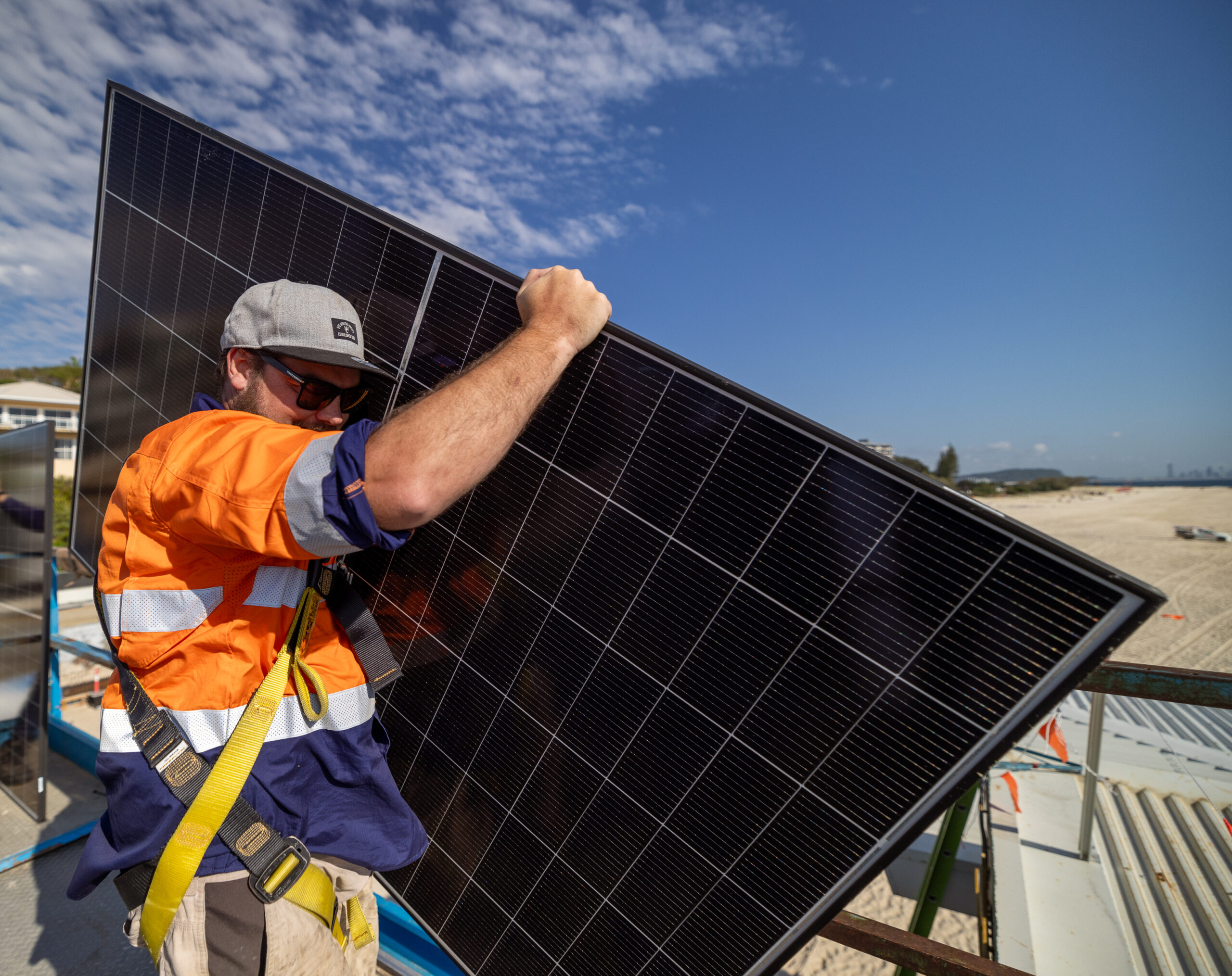

A commercial solar system needs a full inspection by a licensed electrician at least once a year. Queensland’s Electrical Safety Office recommends a yearly inspection, plus a check after storms. Sites near the ocean, or with heavy dust or vegetation, may need more frequent attention.
Solar Set provides commercial solar operations and maintenance across the Gold Coast, Brisbane and Northern NSW. This guide covers what a service should check on a commercial solar system, how often your site needs one, and how to spot a drop in output between visits.
Key Points
- Queensland’s Electrical Safety Office recommends inspecting a solar system at least once a year and after storms, or as the manufacturer requires.
- Sites near the ocean, or with more dust or vegetation, may need inspection and cleaning more often than once a year.
- Maintenance involving electrical work must be done by a licensed electrician, and the regulator advises choosing one who specialises in solar.
- Panels should be cleaned with water only, never with cleaning products, scourers or high-pressure cleaners.
- Remote monitoring catches many faults, but it cannot replace an onsite inspection of cables, terminations and mounting.
- Solar Set’s maintenance work is done by licensed electricians accredited by Solar Accreditation Australia, and our compliance and safety audits are carried out by Clean Energy Regulator inspectors.
How often should commercial solar be maintained?
Book a full inspection at least once a year. That is the baseline the Electrical Safety Office sets for every solar system in Queensland.
The regulator also recommends a check after storms, and says your manufacturer’s requirements may set a different schedule. Coastal, dusty and heavily vegetated sites may need more regular maintenance than the yearly minimum.
Check your panel and inverter warranty terms too. Some manufacturers set their own service intervals, and those intervals override the yearly baseline.
A yearly inspection on the calendar gives you a fixed point to catch problems before they cost you production.
What should a commercial solar service check?
A proper service checks every part of the system that weather, heat and time can wear down. The Electrical Safety Office lists four core checks: damage or deterioration to components, safety switches and devices working properly, panels, frames and cables fixed firmly in place, and debris or vegetation affecting the system.
A commercial service goes further than that list. Cables and terminations are checked for heat discolouration and hotspots. Inverter fans and heat sinks are kept free of dust, because dust traps heat and raises fire risk.
The table below sets out what a commercial service should check and what a problem usually looks like.
| What gets checked | Why it matters | Typical sign of a problem |
|---|---|---|
| Panels | Cracks and soiling cut output and can create hotspots | Cracked glass, heavy soiling or a panel producing less than its neighbours |
| Inverters | The inverter converts your solar power for use on site | Error codes, fan noise, dust build-up or output below expected |
| Isolators and protection devices | They let the system be shut down safely in an emergency | Stiff or damaged switches, water inside enclosures or missing labels |
| Cables and terminations | Loose or degraded connections lose power and can overheat | Heat discolouration, cracked insulation or cables rubbing on the roof |
| Mounting and framing | Rails and clamps hold the array in high winds | Loose clamps, corrosion on fixings or movement in the rails |
| Earthing | Earthing protects people and equipment if a fault occurs | Loose or corroded earth connections on frames and rails |
| Monitoring and data | Data shows whether the system is producing what it should | Gaps in data, a lost connection or a steady decline in output |
Working through every line of this table on each visit means nothing on your roof goes unchecked for more than a year.
Who should maintain a commercial solar system?
A licensed electrician should do any maintenance that involves electrical work. The Electrical Safety Office says this work must be done by a licensed electrician, and it recommends choosing one who specialises in solar.
Look for accreditation as well as a licence. Solar Accreditation Australia has accredited solar installers and designers since 29 February 2024, after the Clean Energy Regulator appointed it to run the scheme.
Solar Set’s maintenance team are licensed electricians accredited by Solar Accreditation Australia. Our compliance and safety audits are carried out by Clean Energy Regulator inspectors, who check a system against Australian standards and identify workmanship defects.
Staff should never climb a commercial roof to look at the system. WorkSafe Victoria describes falls from height as the most serious risk in solar work. Visual checks from the ground are fine, and anything on the roof is a job for a trained crew.
Using a licensed, accredited team keeps your people off the roof and keeps the work compliant.
How should commercial solar panels be cleaned?
Clean panels with water only. The Electrical Safety Office says to avoid cleaning products, scourers and high-pressure cleaners.
The regulator also says panels should be inspected for damage before cleaning, and any damage repaired first. Nobody should lean on panels or rest buckets on them.
How often a site needs cleaning depends on where it is. Dust from nearby roads or industry, bird droppings, pollen and salt spray all build up at different rates. Your inspection should tell you whether cleaning is due.
Cleaning to the regulator’s guidance restores output without damaging the glass.
Do coastal and airport sites need more maintenance?
Yes. The Electrical Safety Office says sites near the ocean may need more regular maintenance than the yearly minimum, and our own projects show why.
Salt air corrodes fixings, framing and electrical connections faster than inland air. Panels for these sites can be tested to IEC 61701, a salt mist corrosion standard. The test simulates a humid, salt-laden atmosphere by spraying modules with a salt solution over several weeks.
At Currumbin Vikings Surf Life Saving Club, our 23kW system sits on the oceanfront at Elephant Rock. We chose Canadian Solar modules for their high wind load capacity and because they passed IEC 61701 Ed2 salt mist testing. Schletter framing was selected because it is designed for storm-strength winds and harsh conditions.
At Brisbane Airport, we installed 2.4MW of solar across four industrial developments. The sites sit in high wind areas and a highly corrosive environment, which required high-quality materials from the start.
Coastal and exposed sites benefit most from a shorter inspection interval, because corrosion found early is a cheap fix and corrosion found late is a replacement.
How do you spot a drop in solar output between services?
Check your monitoring data every month and compare it with the same month last year. A steady decline, or one inverter producing less than the others, is the most common sign that something needs attention.
Look for three patterns in particular. A sudden drop to zero usually points to a tripped inverter or a lost data connection. A gradual decline over months often points to soiling or a degrading component. A drop after a storm can point to physical damage.
Monitoring has limits. Solar Choice notes that many faults cannot be picked up by remote monitoring alone, which is why the yearly onsite inspection still matters.
Module-level monitoring narrows the search. At The Rocks Resort in Currumbin, our 39.6kW system uses SolarEdge inverters and power optimisers. Each panel reports its own output, so a fault shows up against a single panel rather than the whole array.
A monthly look at your data turns a hidden loss into a quick service call.
What happens when a component fails?
Your maintenance provider should handle the warranty claim or the repair for you. Solar Set’s service covers warranty returns as well as repairs and replacements.
For warranty claims, we verify the warranty, review the documentation and assess compliance before the claim goes to the manufacturer. When a component is out of warranty, we repair or replace inverters, panels, wiring and connectors.
Keep your installation documents, warranty certificates and service records in one place. They make every claim faster.
A provider who manages the claim saves you chasing a manufacturer while your system sits idle.
Many maintenance problems start at installation. Our guide to common mistakes to avoid with commercial solar covers the design and installation choices that make a system easier to maintain.
Frequently Asked Questions
How often should commercial solar panels be inspected?
At least once a year. Queensland’s Electrical Safety Office recommends a yearly inspection and a check after storms, and coastal or dusty sites may need more frequent visits.
Can our own maintenance staff service the solar system?
No, not for electrical work. The Electrical Safety Office says maintenance involving electrical work must be done by a licensed electrician, and staff should not access the roof.
Can commercial solar panels be cleaned with a pressure washer?
No. The Electrical Safety Office says to clean panels with water only and to avoid high-pressure cleaners, cleaning products and scourers.
Does remote monitoring replace a yearly inspection?
No. Monitoring shows when output drops, but many faults in cables, terminations and mounting can only be found by an onsite inspection.
Do beachside commercial systems need more maintenance?
Usually, yes. The Electrical Safety Office says sites near the ocean may need more regular maintenance, because salt air speeds up corrosion of fixings and connections.
What does Solar Set’s maintenance service cover?
Our operations and maintenance service covers inspections, compliance and safety audits, warranty returns, and repairs and replacements on commercial systems across the Gold Coast, Brisbane and Northern NSW.
Book a commercial solar inspection
Solar Set will inspect your system and tell you what needs attention. Our licensed, accredited team covers the Gold Coast, Brisbane and Northern NSW.
With Solar Set, you get one team that designs, installs and maintains commercial systems from 23kW surf clubs to 2.4MW airport sites.
Contact us to book an inspection or call 1300 330 923.
