


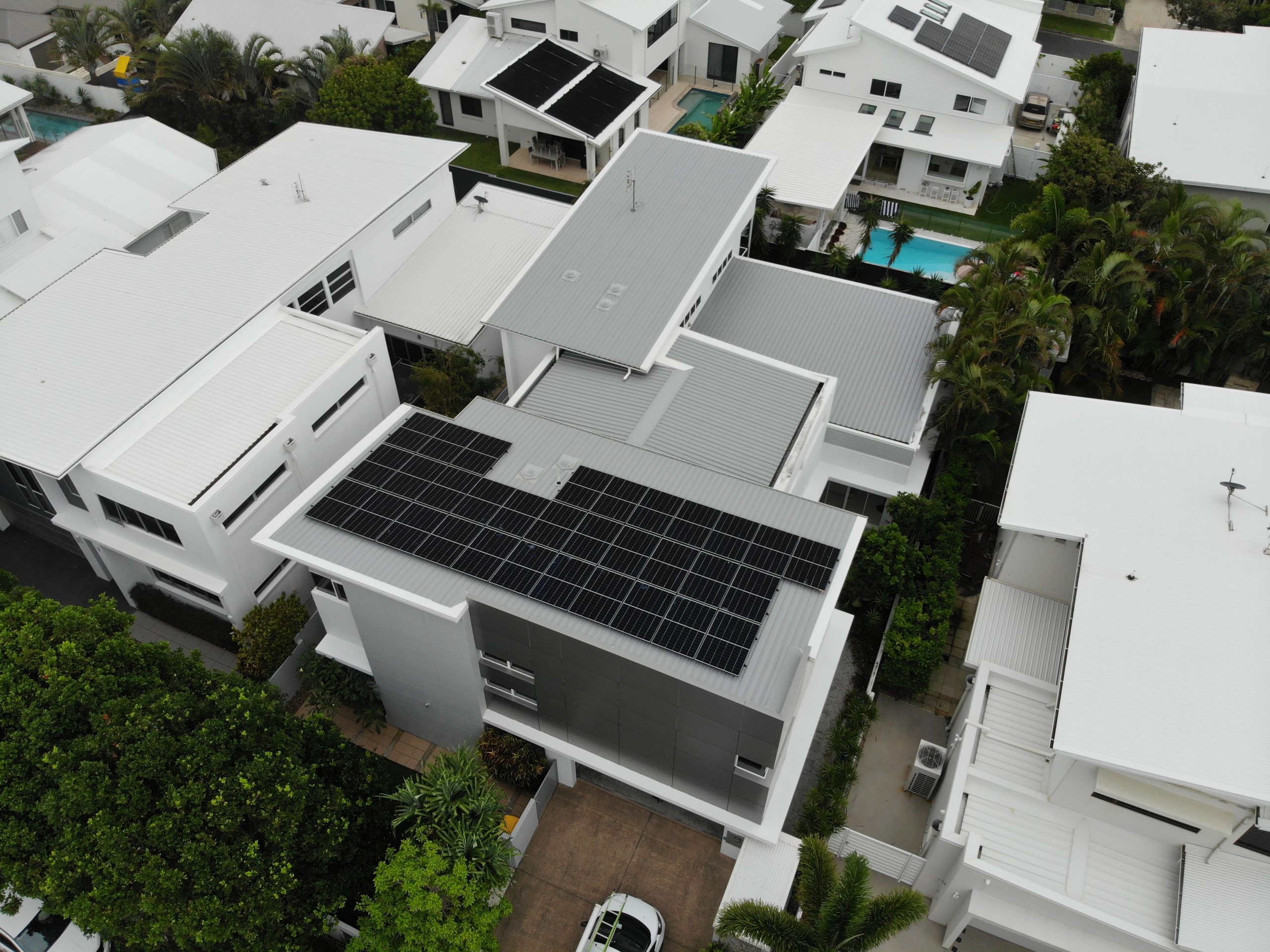

Yes, a Queensland body corporate can claim Small-scale Technology Certificates (STCs) on a common-property solar system, and each lot owner can claim them on a system for their own lot. The current amounts and step-down dates sit on our solar and battery rebates guide for QLD and NSW, so this post covers who can claim and how.
Solar Set designs and installs strata solar and battery systems across the Gold Coast, Brisbane and Northern NSW. This guide covers the QLD consent rules, the federal rebates, the approval steps, the position over the border, and the one question that is still open, which is whether a shared battery qualifies.
Key Points
- A QLD body corporate can claim STCs as a point-of-sale discount on common-property solar, and lot owners can claim them on systems for their own lots.
- Since the 2022 amendments, a body corporate can withhold consent for solar on a common-property roof only to preserve structural integrity, where there is not enough roof space for every other owner, or to prevent pipe noise from solar hot water.
- Owners who are refused consent can use the 4-stage dispute process run by the Office of the Commissioner for Body Corporate and Community Management (OCBCCM), on 1800 060 119.
- There is no clear published answer yet on whether a shared, common-property battery qualifies for the Cheaper Home Batteries Program.
- Our 39.78kW strata system at Hope Island pairs solar with a 30kWh battery to supply the building’s common areas.
- The former Queensland body corporate grant is closed, and STCs step down every year until the scheme ends on 31 December 2030.
Can a body corporate claim STCs on common-property solar?
Yes, a body corporate can claim STCs on solar installed on common property, such as a roof that powers your lifts, lighting and pool pumps. STCs work as a point-of-sale discount for bodies corporate, individuals and businesses alike.
STCs are federal certificates that an eligible system creates under the Clean Energy Regulator’s Small-scale Renewable Energy Scheme. The installer usually takes them in exchange for a discount on your invoice. Most residential strata systems fall inside the scheme’s size limit, and large buildings should confirm the current limit on our rebates guide.
Our Hope Island strata development on the Gold Coast shows how this works in practice. We built a 39.78kW system into the new building during construction, with 68 Canadian Solar 585W panels, a Sungrow SH25T 25kW hybrid inverter and a Sungrow 30kWh battery. It supplies the building’s common areas, such as the lifts and common-area lighting.
You can see the details in our Hope Island strata solar and battery case study. Because the system feeds the common-area supply, the savings land on the shared costs every owner already pays.
STCs step down every year until the scheme ends on 31 December 2030. A 2026 install is credited for five years, a 2027 install for four, and a 2030 install for one. For your building, the STC value comes straight off the price of the system rather than arriving later as a separate payment.
Can a body corporate claim the battery discount for a shared battery?
Nobody can answer this cleanly yet, and we would rather say so than guess. The Cheaper Home Batteries Program is the federal battery discount, and it runs through the same certificate system as STCs.
Under the Clean Energy Regulator’s solar battery rules, a battery must be paired with solar, be on the Clean Energy Council approved list, and be installed by a Solar Accreditation Australia accredited installer with a battery endorsement. The battery must also be able to join a virtual power plant (VPP), which is a group of batteries a provider manages together.
The program allows one claim per premises, which for a grid-connected building means one per meter. A reported Clean Energy Regulator webinar answer says an apartment counting as a premises is eligible if it has solar, which would let each lot claim for its own battery. Confirm this with the Clean Energy Regulator before your committee relies on it.
Nobody has published a clear answer on a battery that sits on common property and serves the whole building. Ask for any shared-battery quote to show the price with and without the discount, so your committee never votes on a figure that later falls away.
Common property or individual lots: which suits your building?
The right setup depends on who uses the power and which meter the system feeds. A common-property system feeds the common-area meter, while an individual-lot system feeds one owner’s own meter.
Some buildings run an embedded network, where power is on-sold to lots through a parent meter. Our own licensed team checks the parent meter, the lot meters, the switchboard and the roof during a free assessment, and confirms who manages the embedded network before any design is drawn.
On the Gold Coast and in Brisbane, the connection goes to Energex, while Tweed and Kingscliff buildings connect through Essential Energy. Your installer applies to the right network before anything goes on the roof.
Getting the meter question right first means the solar lands where your building actually uses power.
| Question | Common-property system | Individual-lot system |
|---|---|---|
| Who owns it? | The body corporate | The lot owner |
| What does it power? | Lifts, lighting, pool pumps and other common areas | One lot’s own use |
| Who gets the STCs? | The body corporate, as a point-of-sale discount | The lot owner, as a point-of-sale discount |
| Does the battery discount apply? | Unresolved for shared batteries | One claim per meter, to be confirmed with the Clean Energy Regulator |
| Who decides? | The body corporate, through the approval path your body corporate manager confirms | The owner, with body corporate consent for a common-property roof |
| Who pays? | Body corporate funds, shared among owners as your body corporate manager advises | The lot owner |
| Can consent be refused? | Not applicable | Only for structural integrity, insufficient roof space for every owner, or pipe noise from solar hot water |
Can the body corporate refuse an owner’s solar?
A body corporate can refuse only on narrow grounds. Since the 2022 amendments, it can withhold consent for solar on a common-property roof only to preserve structural integrity, where there is not enough roof space for every other owner to install too, or to prevent pipe noise from solar hot water.
If you are refused on other grounds, the OCBCCM runs a 4-stage dispute process, as Business Queensland’s guide to body corporate by-laws explains. You can call the OCBCCM on 1800 060 119 to start.
The roof-space ground matters most on a tower, where one owner’s array can take space the others need. A layout plan for the whole roof answers that question before it becomes a dispute, and puts you on firm footing when you raise solar at your next meeting.
What are the steps from committee to switch-on?
A strata solar project runs smoothest when your committee follows this order. Your body corporate manager is the right person to confirm the approval path and how the cost would be shared for your scheme.
- Start with a site assessment, where a licensed installer checks roof space, structure, shading, the switchboard, the meter setup and where a battery could safely sit.
- Ask your body corporate manager whether the decision sits with the committee or needs a general meeting vote, and what kind of motion it needs.
- Get comparable quotes that show the STC discount as a line on the invoice and price any shared battery with and without the battery discount.
- Ask your body corporate manager how the cost would be shared among owners and whether it would come from existing funds or a special levy.
- Have the installer lodge the connection application with Energex or Essential Energy before the install.
- Install and commission, with all wiring, switchboard and battery work done by licensed electricians and never by owners or committee members.
Is there a strata grant in QLD or over the border in NSW?
No, there is no Queensland strata grant open now. The former Queensland body corporate grant for batteries or solar-battery systems is fully subscribed and closed, and the Battery Booster closed in May 2024.
Tweed Heads and Kingscliff buildings sit in NSW, so NSW schemes apply there instead. NSW has run grants for apartment solar and pays an incentive when a battery joins a virtual power plant, so check what is open on the NSW Government site before your committee counts on it.
We already work on the NSW side of the border, including a 14kW solar and battery install in Kingscliff on the Essential Energy network. For a Tweed building, that means the federal discounts plus any NSW incentive that is open on the day you sign.
Frequently Asked Questions
Can our body corporate get the solar rebate in QLD?
Yes, a QLD body corporate can claim STCs on common-property solar. STCs work as a point-of-sale discount, so the value comes off the price of the system up front.
Can each unit owner claim the battery rebate separately?
Probably, but it still needs confirming with the Clean Energy Regulator. The Cheaper Home Batteries Program allows one claim per premises, and a reported regulator webinar answer says an apartment counting as a premises is eligible if it has solar.
Can the body corporate say no to solar on our roof?
Only on narrow grounds. A body corporate can withhold consent for solar on a common-property roof only for structural integrity, insufficient roof space for every other owner, or pipe noise from solar hot water, and refused owners can use the OCBCCM’s 4-stage dispute process on 1800 060 119.
How is the cost of strata solar shared between owners?
Your body corporate manager can tell you how the cost would be shared in your scheme. Ask whether it would come from existing funds or a special levy before the vote, so every owner knows their share.
Is there a Queensland grant for strata solar?
No, there is no Queensland strata grant open now. The former body corporate grant is fully subscribed and closed, and the Battery Booster closed in May 2024, so the federal STCs and battery discount are what remain.
Get your strata solar options checked
Solar Set will assess your roof, meters and switchboard, then show what your body corporate and lot owners can claim. You get a quote your committee can take to a vote, with the STC discount shown on the invoice. Call 1300 330 923 or check the current figures on our solar battery rebates page.
