


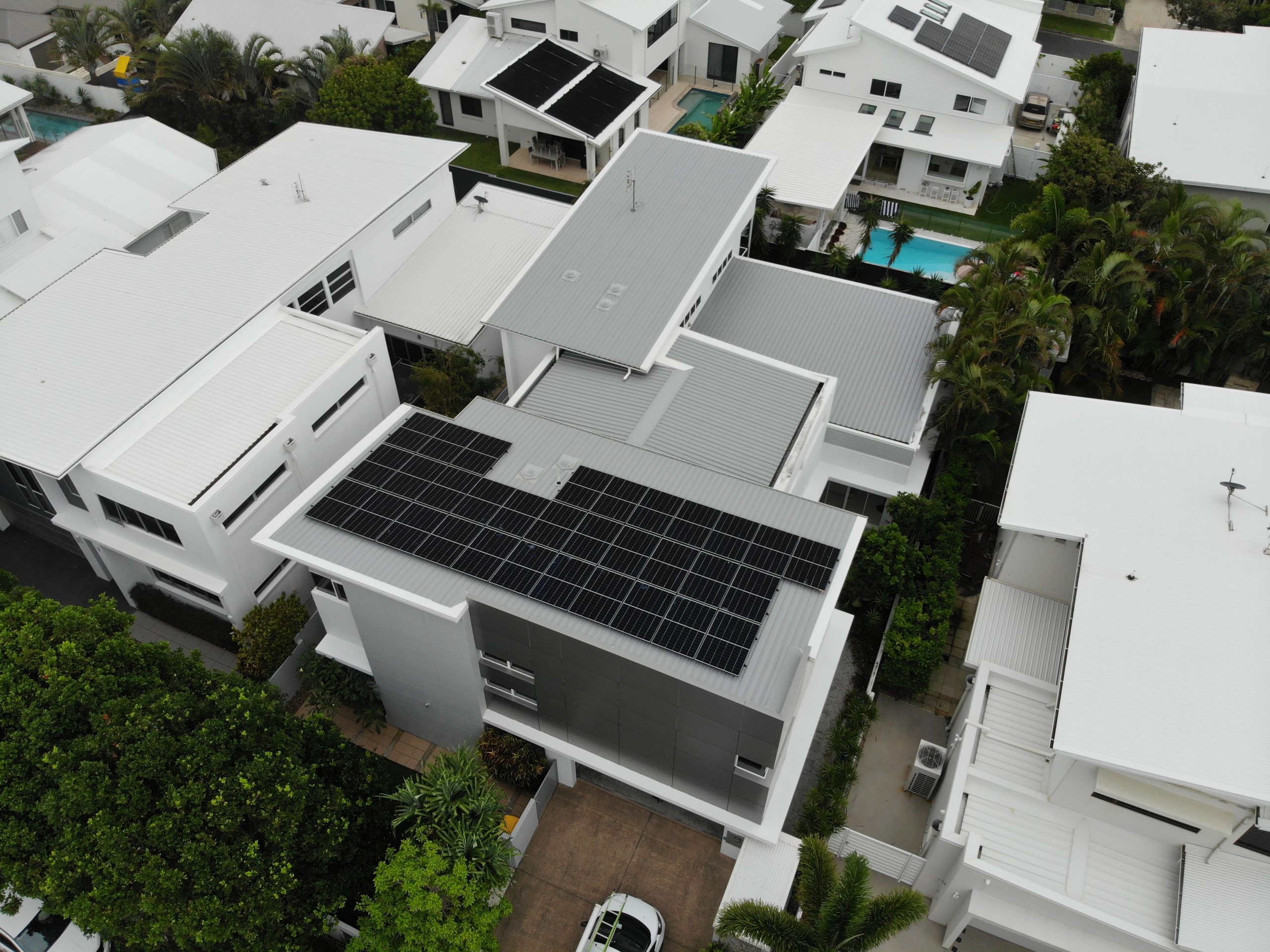

A standard 6.6kW solar system on the Gold Coast costs about $5,900 for a typical install, according to What’s The Damage’s Gold Coast cost guide. Its standard quotes run from $3,925 to $8,350, and premium systems run from $6,350 to $10,300.
Solar Set designs and installs residential solar on the Gold Coast, in Brisbane and in Northern NSW. This guide explains what each end of that range buys, why quotes differ, and how the federal discount comes off your price.
Updated October 2026. Market prices below are as each source listed them in October 2026.
Key Points
- What’s The Damage lists a standard 6.6kW Gold Coast system at $3,925 to $8,350, with a typical price of $5,900.
- Solar Calculator’s Gold Coast averages of $6,380 for 6.6kW and $9,666 for 10kW work out at almost the same price per kW, so on these averages a bigger system is not cheaper per kW.
- Solar Set’s solar and battery packages were listed from $7,299 to $14,999 on 29 October 2026, including the STC discount.
- Gold Coast postcodes sit in Zone 3 with a rating of 1.382, so a 6.6kW system installed in 2026 earns 45 Small-scale Technology Certificates.
- The solar deeming period drops from 5 years in 2026 to 4 years in 2027, so the same system earns a smaller discount next year.
- South East Queensland has no regulated minimum feed-in tariff, so check your retailer’s current rate before you size a system.
What does solar cost on the Gold Coast in 2026?
Gold Coast homeowners will see published 6.6kW prices from $3,925 at the budget end to $10,300 for premium gear. Solar Calculator’s Gold Coast price page puts the average at $6,380 for 6.6kW and $9,666 for 10kW.
Divide each average by its system size and the two work out at almost the same price per kW. On these averages, a bigger system is not cheaper per kW. The wide ranges come from what each quote buys, which the next section explains.
An older Solar Choice guide to Gold Coast solar gave $6,000 to $7,500 for 6kW and $9,500 to $12,000 for 10kW, including STCs and GST. Treat older figures as a guide only, because the discount has stepped down since.
Our solar and battery packages were listed from $7,299 to $14,999 on 29 October 2026, including the STC discount. Those packages include a battery or a battery retrofit, so check the packages page for the current price on the day you compare.
Knowing what each figure covers lets you compare quotes on equipment, not just on the total.
| Source | System | Price |
|---|---|---|
| What’s The Damage | 6.6kW standard | $3,925 to $8,350 (typical $5,900) |
| What’s The Damage | 6.6kW premium | $6,350 to $10,300 |
| Solar Calculator | 6.6kW average | $6,380 |
| Solar Calculator | 10kW average | $9,666 |
| Solar Choice (older guide) | 6kW | $6,000 to $7,500 |
| Solar Choice (older guide) | 10kW | $9,500 to $12,000 |
| Solar Set packages, 29 October 2026 | Solar and battery packages | From $7,299 to $14,999 |
Why do Gold Coast solar quotes differ so much?
Two quotes for the same size system can be far apart because they buy different equipment and different work. Whatever the price, ask your installer exactly what is included.
We look at your roof and your switchboard before we quote. We check whether the roof is tile or tin, whether your home runs on single-phase or three-phase power, whether the switchboard needs work, and how much salt air the site gets. What’s The Damage also notes that the Gold Coast sits in wind region B, which affects how panels are mounted.
The high end buys premium panels, a hybrid inverter that runs a battery as well as your panels, and extra work on harder roofs. Our installs show the range. From a 26.35kW system of Australian-made Tindo panels on a new home in Mudgeeraba, to 39.6kW with SolarEdge optimisers on a 12-level beachfront apartment block in Currumbin, each system is designed around its roof.
- Panel brand and model change the price, so ask which panels are in your quote.
- Single-phase or three-phase power changes the inverter and the connection work in your quote.
- An older switchboard may need an upgrade before solar connects. Our guide to whether you need a switchboard upgrade for solar explains the four checks.
- Roof obstructions or shade may call for optimisers, which are small devices that let each panel work on its own, as they did at The Rocks.
- Apartment and townhouse owners usually go solar through the body corporate, like our 39.78kW strata solar and battery system at Hope Island.
How does the STC discount work on the Gold Coast?
Small-scale Technology Certificates (STCs) are federal certificates your system earns, and your installer takes their value off your price. The Clean Energy Regulator’s STC rules base the count on system type, size, location, install date and the deeming period.
The sum is system kW multiplied by the zone rating and the deeming years, rounded down. Gold Coast postcodes such as 4217, 4220, 4226 and 4227 are Zone 3 with a rating of 1.382, and so is Brisbane.
A 6.6kW system installed in 2026 works out at 6.6 times 1.382 times 5, which rounds down to 45 certificates. The dollar value moves with the certificate price, so we keep current figures on our solar and battery rebates page.
The discount shrinks each January because the deeming period falls by one year until the scheme ends in 2030. A system installed in January 2027 earns certificates on 4 years instead of 5. Seeing the sum lets you check the STC line on any quote yourself.
| Install period | Solar deeming years | Battery factor per usable kWh |
|---|---|---|
| May to December 2026 | 5 | 6.8 |
| January to June 2027 | 4 | 5.7 |
| July to December 2027 | 4 | 5.2 |
| 2028 | 3 | 4.6, then 4.1 |
| 2029 | 2 | 3.6, then 3.1 |
| 2030 | 1 | 2.6, then 2.1 |
Is there a QLD rebate, and what does a battery add?
Most Gold Coast homeowners get their discount from the federal schemes, because Queensland’s Battery Booster closed in 2024. A battery adds to the price, and the federal Cheaper Home Batteries Program takes part of it back. The CER says its factor is set to give a discount of around 30 per cent of the upfront cost.
The battery factor applies in tiers: 100 per cent up to 14kWh, 60 per cent from 14 to 28kWh and 15 per cent from 28 to 50kWh. Our guide to the QLD solar battery rebate works through it in detail.
Landlords have one extra option. Queensland’s Supercharged Solar for Renters program offers a rebate for solar on eligible rental homes, and our guide to solar rebates on a rental property covers who qualifies.
From a 19.8kW system with a 25kWh battery in Hollywell to a 15.5kW system with a 20kWh battery on a short-term rental in Kingscliff, the battery is sized to how the home uses power. Knowing how the discount works lets you judge a battery quote on what you actually pay.
What can you export to Energex, and what is the feed-in tariff?
Energex sets how much your system may export to the grid when it approves your connection. A good design works within that limit, so your panels are not sized for power you cannot send anywhere.
Your feed-in tariff is set by your retailer, not by Energex. South East Queensland has no regulated minimum feed-in tariff, so retailer offers are the market.
Check your retailer’s current rate before you size your system. The solar you export earns far less than the power you buy back at night, which is the gap a battery can capture. Sizing around the power you will actually use keeps your money in the system that pays you back.
What should a quote itemise, and who should install it?
A good quote lists every part and every job, so you can compare it line by line. Walk away if a quote hides the brands or promises guaranteed savings.
Coastal homes need marine-grade rail and stainless fixings, because salt corrodes ordinary fixings first. We specify them for coastal homes from Burleigh Heads to Coolangatta.
Your installer should hold an electrical licence in your state and Solar Accreditation Australia (SAA) accreditation, which the Clean Energy Regulator requires for STCs. Solar Set holds Queensland Electrical Licence 89708 and NSW Contractor Licence 386235C, our directors hold SAA accreditation, and we are a Tesla Powerwall Certified Installer.
Every system is designed by our in-house engineering team and installed by our own licensed team, with more than 72MW installed since 2011. Business owners get no published price, because each commercial system is sized to the site’s load after an assessment, as with our 39.9kW solar and 60kWh battery system at the BYD Burleigh dealership.
With Solar Set, you get one licensed team accountable from design to connection.
- The quote names the panel brand, model and number of panels.
- The quote names the inverter brand and says whether it is a string, micro or hybrid inverter.
- The quote shows the STC discount as its own line.
- The quote names the mounting rail and fixings, and says whether they are coastal-rated.
- The quote lists any switchboard, metering or three-phase work.
- The quote states the export limit Energex is expected to approve.
Frequently Asked Questions
How much is a 6.6kW solar system on the Gold Coast?
A typical standard 6.6kW system costs about $5,900, according to What’s The Damage. Its standard range runs from $3,925 to $8,350, premium systems run from $6,350 to $10,300, and Solar Calculator puts the average at $6,380.
Is a bigger solar system cheaper per kW on the Gold Coast?
Not on the published averages. Solar Calculator gives $6,380 for 6.6kW and $9,666 for 10kW, and dividing each by its size gives almost the same price per kW.
Is there a Queensland rebate for solar panels in 2026?
Most Gold Coast homeowners rely on federal STCs and the Cheaper Home Batteries Program, because the Battery Booster closed in 2024. Landlords can also check Queensland’s Supercharged Solar for Renters program.
Should I wait until 2027 to install solar on the Gold Coast?
Waiting will not increase your discount. The solar deeming period drops from 5 years to 4 in 2027, and the battery factor drops from 6.8 to 5.7 in January 2027.
Which accreditation should my solar installer have?
Your installer should hold an electrical licence in your state and Solar Accreditation Australia (SAA) accreditation. The Clean Energy Regulator requires SAA accreditation for systems that earn STCs.
How long does solar take to pay for itself on the Gold Coast?
It depends on your own bill, your evening use and your retailer’s feed-in tariff, so we will not quote a figure without them. South East Queensland has no regulated minimum feed-in tariff, so the power you use yourself is worth more than the power you export.
Get a Gold Coast solar price built for your roof
Book a free assessment and Solar Set will look at your bill, your roof and your switchboard, then give you an itemised quote with every brand and the STC discount shown. Call 1300 330 923 or see our residential solar page.
